
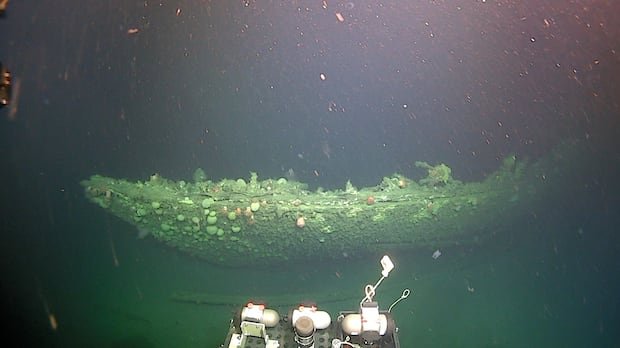

After spending 80 years at the bottom of the Labrador Sea, the Terra Nova appears significantly altered from its days carrying renowned British explorer Robert Falcon Scott to the South Pole.
Describing the ship as a wreck in poor condition but intriguing due to its state, David Mearns, the co-chief scientist on the Canadian-led mission to document the vessel, shared his insights.
The discovery of the ship was made in 2012 off the coast of Greenland by Mearns, but this recent scientific expedition marks the first time detailed imagery of the Terra Nova has been brought back.
This expedition, led by the Royal Canadian Geographical Society, is focusing on examining two shipwrecks using remotely operated vehicles (ROVs) and an underwater submersible, with the Terra Nova being the second vessel studied following the recent exploration of the Quest, the ship that carried Sir Ernest Shackleton on his final voyage to Antarctica.
Recently, the team onboard the research ship Atlantis utilized an ROV overnight to map the Terra Nova wreck, offering a glimpse of the vessel that set sail in 1884 before its fateful journey with Scott in 1910.
Now situated at a depth of 170 meters, approximately 30 kilometers south of Greenland following its sinking in 1943, the Terra Nova’s double wheels, used by the crew to navigate the 57-meter sail and steam ship, are clearly discernible. Other ship components such as the rudder, boilers, and steam winches remain visible as well.
The technology developed by Voyis, a company based in Waterloo, Ont., not only captures images and videos but also generates a three-dimensional map of the entire ship.
Kirstin Meyer-Kaiser, a marine biologist involved in the expedition, emphasized that the 3D model provides comprehensive context for their research, enhancing the understanding of the ship’s layout and aiding in future studies.
According to Dwight Coleman, the co-chief scientist and director of ocean imaging at the Woods Hole Oceanographic Institution in Massachusetts, technological advancements have streamlined the process, eliminating the need to manually stitch numerous photos together for a holistic view.
Coleman highlighted the significance of studying northern shipwrecks in detail, emphasizing the unique opportunity presented by the current camera systems to gather valuable information.
Marine biologist Kirstin Meyer-Kaiser is investigating the marine life that has colonized the Terra Nova wreck after its abandonment, noting the abundance of redfish and other species using the structure as a habitat.
She aims to comprehend the implications of human-made objects like shipwrecks in marine ecosystems to better predict the impacts of future ocean installations.
John Geiger, the president of the Royal Canadian Geographical Society leading the expedition, described the exploration of the Terra Nova and Quest as a poignant moment, paying tribute to these vessels that were at the forefront of exploration during their time.
More than a century later, with the aid of cutting-edge ocean technology, the expeditions led by Scott and Shackleton are being documented, providing valuable insights for contemporary research.