
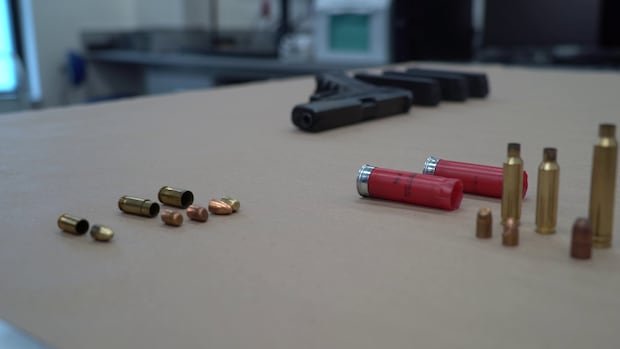

London, Ontario has seen a surge in reported shootings, with the count reaching 20 in 2025. In response, law enforcement authorities are diligently working to track down the sources of illegal firearms and remove them from circulation.
The Firearms Analysis and Tracing Enforcement (FATE) process, overseen by the Guns and Gangs Section of the London Police Service (LPS), has identified the origins of 31 guns this year. The police provided CBC London with insights into the investigative process, shedding light on how they uncover details ranging from gun ownership to the weapons’ origins.
Unveiling Clues Through Forensics
When a firearm arrives at the Forensics Identification Section lab, Detective Constable Craig Walsh, a forensic expert, immediately begins the process of searching for clues. The lab, equipped with advanced technology, is where the investigation kicks off, starting with a fundamental yet crucial step.
“DNA analysis plays a significant role in our forensic work. Our initial focus is on collecting DNA samples by swabbing the firearm’s textured surfaces,” explained Walsh.
The swab is then sent to the Centre for Forensic Science in Toronto for analysis. Walsh highlighted that detecting DNA from multiple individuals on a single firearm can provide valuable leads for making arrests and seizing guns.
Following DNA collection, Walsh shifts his attention to fingerprint analysis.
“Fingerprints left on a firearm can be a crucial identification marker,” Walsh remarked, demonstrating the process on a Glock handgun, a commonly encountered weapon at the lab.
Employing a brush and fine powder, Walsh dusts the smooth areas of the gun to reveal any latent fingerprints, which are later processed for comparison in the RCMP national fingerprint database.
Exploring Distinctive Gun “Fingerprints”
Aside from human fingerprints, firearms themselves possess unique identifying marks, according to Walsh.
Using the indoor shooting range at LPS, Walsh can fire a gun and recover the bullets, which retain the gun’s distinctive “fingerprint.”
“Each firing pin leaves a distinct mark on the cartridge primer, creating a unique identifier on every cartridge case,” Walsh elaborated.
By uploading these gun imprints to an international database, investigators can cross-reference them with evidence from other crime scenes to identify potential matches.
Adapting to Criminal Tactics
Walsh noted that criminal behavior around weapon use evolves over time, necessitating constant adaptation by forensic experts.
One emerging challenge is the presence of “ghost guns,” 3D-printed firearms devoid of conventional serial numbers. Despite the difficulty in tracing them, DNA and fingerprint evidence can still be instrumental in investigations.
Most firearms processed at the lab are factory-made handguns, with a trend of criminals refraining from tampering with serial numbers to avoid detection, as recovering these numbers is within law enforcement’s capabilities.
Det. Sgt. Jon Meinen emphasized the direct impact of lab work on field operations, citing a high success rate in tracing gun origins and sales history. The majority of traced firearms, 76% this year, are found to originate from the United States, with a consistent trend over recent years.
Guns are frequently associated with gang and drug activities, and efforts to trace their origins aim to prevent their entry into the community, ultimately reducing gun-related incidents.