
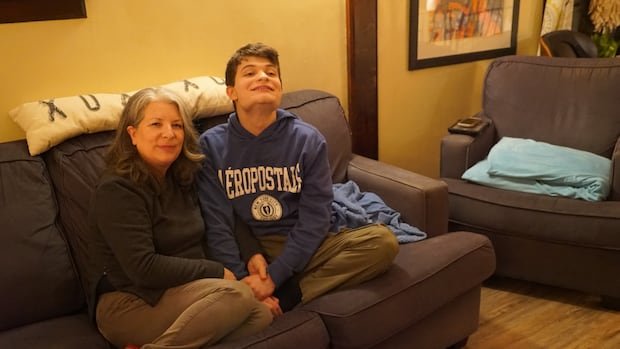

A mother in Waterloo is advocating for her son’s right to use a communication method not recognized by the Waterloo Regional District School Board (WRDSB). Jude Valant, a 19-year-old student at Bluevale Collegiate Institute, relies on the Rapid Prompting Method (RPM) to communicate due to his severe autism and non-verbal nature.
RPM enables Jude to spell out words and sentences by pointing to letters on a board, allowing him to convey his thoughts, opinions, and even humor. Despite its effectiveness for Jude, the WRDSB prohibits the use of RPM in school, which his mother, Melissa Valant, believes hinders his ability to express himself authentically.
Melissa, who is also a part-time teacher, argues that the school board’s rigid stance reflects a broader issue in special education – the failure to recognize individual communication needs. She stresses the importance of personalized approaches for autistic students, rather than applying a one-size-fits-all policy.
Introduced to RPM at the age of nine, Jude surprised his mother by articulating profound thoughts, demonstrating his intellectual capabilities beyond expectations. However, the WRDSB rejected RPM as an approved method, leaving Melissa feeling disheartened by their decision-making process.
The WRDSB justifies its stance by emphasizing the consultation of professional teams in determining appropriate resources for students. According to the board, RPM does not align with endorsed methods, and alternative evidence-based approaches are explored to meet individual student needs.
Challenges with RPM arise from concerns about the authenticity of the communicated messages. Sari Risen, a speech-language pathologist, highlights the potential for unintentional guidance in RPM communication, raising doubts about its reliability. She cautions that misinterpretation of a student’s abilities based on RPM output could lead to inappropriate educational placements.
Melissa advocates for accommodating Jude’s communication needs on a case-by-case basis, urging the school to consider what works best for him. She emphasizes the importance of individualized support for autistic individuals, mirroring the flexibility offered to neurotypical students.
As Jude navigates his high school years, Melissa remains steadfast in her pursuit of allowing him to utilize RPM for effective communication. She believes that every child, including those with autism, deserves to be heard and understood in their educational environment.