
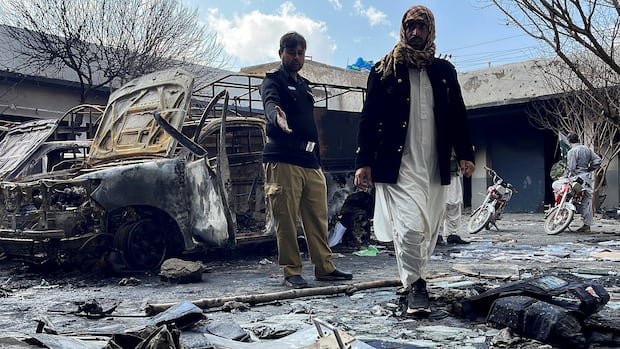

Pakistani security forces successfully neutralized 145 militants in a prolonged 40-hour confrontation following a series of coordinated gun and bomb attacks throughout Balochistan that resulted in nearly 50 casualties, as reported by the province’s chief minister on Sunday. The southwestern region is currently grappling with one of the most intense escalations in recent memory, with insurgents intensifying assaults on security forces, civilians, and infrastructure in the resource-rich province bordering Iran and Afghanistan.
Disguised as ordinary civilians, assailants infiltrated hospitals, schools, banks, and markets on Saturday, unleashing gunfire, as disclosed by Pakistan’s junior interior minister Talal Chaudhry. Chaudhry noted that the attackers masqueraded as civilians and callously targeted innocent individuals, utilizing civilians as shields during the attacks.
The Baloch Liberation Army, a banned separatist group, claimed responsibility for the assaults, citing a coordinated initiative named Herof, or “black storm,” aimed at security forces across the province. The aftermath in Quetta, the provincial capital, included charred vehicles at a police station, bullet-riddled structures, and cordoned-off streets, with heightened security measures and restricted movements enforced in the area post-attacks.
Chief Minister of Balochistan Sarfraz Bugti confirmed that the militant onslaught resulted in 17 law enforcement personnel and 31 civilian fatalities. Pakistan’s military reported the elimination of 92 militants on Saturday and 41 on Friday. Bugti indicated that pre-emptive operations were initiated based on intelligence indicating the planned attacks.
The recent casualties mark the highest number of militants eradicated in a condensed timeframe since the insurgency escalated, Bugti remarked, without presenting precise comparative statistics. The coordinated militant offensives targeted Quetta, Gwadar, Mastung, and Noshki districts concurrently, with armed individuals attacking security installations, attempting suicide bombings, and obstructing urban roads, prompting extensive countermeasures by the army, police, and counterterrorism units.
Jamil Ahmed Mashwani, a private security guard outside a damaged shop, recounted being assaulted by the attackers shortly after midday. The assaults in Balochistan, Pakistan’s most extensive and economically disadvantaged province, stem from a prolonged insurgency led by ethnic Baloch separatists seeking enhanced autonomy and a larger share of natural resources.
Pakistan’s Defence Minister Khawaja Asif highlighted the involvement of female perpetrators in two of the attacks, emphasizing the militants’ increased targeting of civilians, laborers, and low-income communities. The military affirmed that security forces successfully thwarted all attempts by militants to seize control of cities or vital installations.
Pakistan’s military attributed the attacks to “Indian-sponsored militants,” an assertion refuted by India, Pakistan’s neighboring adversary, which accused Islamabad of diverting attention from its internal issues. The United States condemned the acts of violence, with U.S. deputy chief of mission Natalie Baker denouncing the incidents as terrorist acts and expressing solidarity with Pakistan. The Balochistan Liberation Army holds the designation of a foreign terrorist organization by the U.S.
Although Pakistan has faced sporadic militant attacks across the country, including those linked to factions associated with the Pakistani Taliban, the recent wave of violence in Balochistan underscores the ongoing security challenges in the region.