
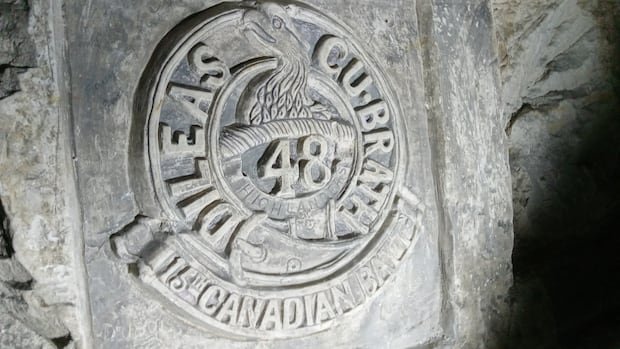

Descending into the Earth by gripping an orange rope, we made our way down a long staircase while crouching to avoid the low stone ceiling. Reaching a depth of 40 feet, we found ourselves at the base of Maison Blanche souterrain, a chalk quarry in northern France. This underground site served as a living space for numerous Canadian soldiers during the First World War, where they not only resided but also left behind intricate carvings on the soft chalk walls.
Volunteers from Canadigm and the U.K.-based Durand Group have been diligently visiting the quarry to document these historical markings made by Canadian soldiers over a century ago. During a visit in October, we explored the area with David Hedges from the Durand Group, who shared poignant stories of the soldiers who once inhabited this space.
The walls were adorned with detailed carvings ranging from cap badges to depictions of animals and faces, offering a glimpse into the soldiers’ thoughts and emotions during their time in the quarry. Among the carvings were personal touches like a mailbox where soldiers could leave letters to their loved ones before battle, with the option to retrieve them if they survived.
The cave’s cool temperature and capacity to house around 200 men were highlighted by Zenon Andrusyszyn, Canadigm’s artistic and executive director. He emphasized the significance of the carvings, some dated just weeks before the Battle of Vimy Ridge in April 1917, shedding light on the soldiers’ experiences and fears during that historic period.
The ongoing efforts to document and preserve these carvings using advanced 3D scanning technology were also discussed, showcasing the dedication of the volunteers in ensuring that these historical artifacts are safeguarded for future generations. The collaborative work of Canadigm and the Durand Group aims to not only honor the memory of the soldiers but also to create a platform where individuals can connect with Canada’s heritage through these tangible remnants of the past.