
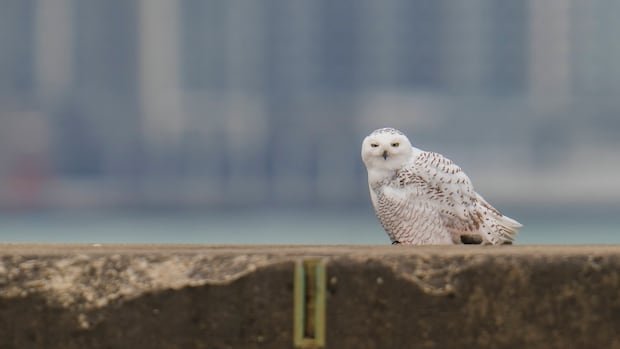

This year presents a unique opportunity for observing snowy owls in southern Canada. The Owl Foundation, a rehabilitation center in Ontario’s Niagara region, recently mentioned on social media that they have already received two young snowy owls, hinting at a potential increase in snowy owl sightings. This surge in the local population of snowy owls, known as an irruption, has resulted in more young snowy owls being spotted earlier than usual in southern Canada and the northern U.S. Researchers suggest that this may offer a chance to witness the rare visitor from the North that was recently classified as threatened by the Committee on the Status of Endangered Wildlife in Canada.
According to Brian Hayhoe, a wildlife biologist and rehabilitator at The Owl Foundation, the center typically receives zero to two snowy owls each winter, with sightings usually not occurring until December or January. Reports from other wildlife centers in Ontario also indicate higher numbers of snowy owls being reported earlier than expected, highlighting a potential trend. As for snowy owl sightings, they have been predominantly observed in the central and western Great Lakes and the Prairies, with some rare sightings as far west as British Columbia.
An irruption, characterized by a significant movement of birds, occurs periodically, unlike the regular seasonal migrations. Guy Fitzgérald, a veterinarian specializing in wild birds of prey at the Université de Montréal, mentions that snowy owls tend to move south in large numbers approximately every six years during an irruption. While previous irruptions were documented in 2017-2018 and 2020-2021, the most substantial irruption in recent history was in 2013-2014 when thousands of snowy owls descended from the subarctic regions.
Experts suggest that irruptions are influenced by the abundance of lemmings, a crucial food source for snowy owls, in the Arctic. In years with plentiful lemmings, snowy owls produce more offspring, leading to numerous nests in a concentrated area. This phenomenon results in the need for owls to venture south in search of food during the fall season. While snowy owls are a common sight in the Prairies due to their suitable habitat, they can also be found along coastlines where they hunt waterfowl trapped in ice.
To observe snowy owls responsibly, experts recommend maintaining a distance to avoid disturbing the birds. Connecting with nature through snowy owl sightings is encouraged, but caution is advised to prevent any disruption to the owls’ behavior. Conservationists emphasize the importance of respecting wildlife and their natural habitats while enjoying these remarkable avian visitors.