
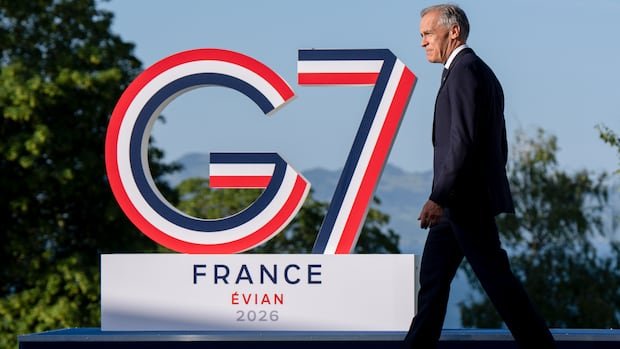

Canada is positioned to emerge as a crucial and dependable energy provider to the G7 nations following a meeting in France where leaders acknowledged the country’s potential to offer “significant additional capacity” to global markets. This move aims to lessen reliance on oil and gas passing through the volatile Strait of Hormuz.
During discussions in Évian-les-Bains, France, G7 leaders pledged to hasten the diversification of energy supply routes to mitigate global vulnerability at the Strait of Hormuz. They expressed support for Canada’s ability to contribute substantial energy capacity to international markets in the upcoming years.
Prime Minister Mark Carney also unveiled new partnerships focusing on critical minerals, which are projected to attract over $5 billion in capital investment for projects across Canada’s critical minerals value chain.
Carney emphasized the necessity for diversifying global energy supply routes away from the bottleneck at the Strait of Hormuz during his closing news conference. He stressed the importance of learning from recent geopolitical events to ensure energy security.
Prior to the conflict, around 20% of the world’s crude oil was transported through the Persian Gulf states, the Strait of Hormuz, and the Gulf of Oman before reaching global destinations. Disruptions caused by Iranian attacks on vessels navigating through the Strait of Hormuz led to a halt in oil shipments and a surge in global energy prices.
Canada is already advancing towards boosting its energy production, with ongoing major liquefied natural gas projects and plans to enhance the output of the TMX oil pipeline. Additionally, the potential construction of two new pipelines from Western Canada highlights Canada’s growing energy production capabilities.
The G7 leaders also addressed a range of issues in joint statements, including commitments to collaborate on critical mineral production to reduce dependency on a single supplier outside the G7. Building on the Critical Minerals Production Alliance established during Canada’s 2025 G7 hosting, the leaders pledged to enhance processing and industrial capacities to diversify critical minerals value chains.
Canada welcomed 13 new partnerships and initiatives with multiple countries at the summit, in addition to forging critical mineral partnerships with various nations. Notable partnerships include an agreement with a German company, RCT Solutions, for a high-purity silica project and solar manufacturing hub in Manitoba.
Despite these advancements, Conservative MP Ellis Ross raised concerns about Canada’s permitting process for new energy projects, citing complexities that could hinder significant increases in oil and gas production. Ross highlighted unanswered questions regarding consultation with Indigenous communities and permit issuance responsibilities within Canada’s energy sector.