
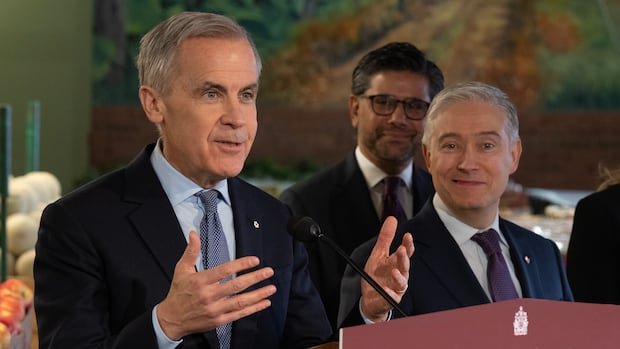

Prime Minister Mark Carney unveiled a package of affordability initiatives on Monday aimed at assisting Canadian families grappling with the escalating cost of living. The focal point of the announcement is the Canada Groceries and Essentials Benefit, a program projected to enhance the GST rebate received by families and individuals over the next five years.
Carney emphasized the government’s commitment to supporting vulnerable Canadian families by leveraging the GST rebate tailored for low and modest-income individuals, as these groups allocate a significant portion of their budgets to groceries and essential items.
In the initial year, eligible low- and modest-income Canadians will receive a one-time increase in the GST rebate, elevating the annual amount for a family of four from $1,100 to $1,890 and for an individual from $540 to $950. Subsequently, starting in 2026/27 for the subsequent five years, the GST rebate will see a 25% increment, translating to an annual sum of up to $1,400 for a family of four and approximately $700 for an individual.
Addressing the soaring food prices outpacing inflation, Carney announced the allocation of $500 million from the government’s Strategic Response Fund to aid food suppliers in expanding their capacity and bolstering productivity. Moreover, a $150 million Food Security Fund was introduced to support small- and medium-sized enterprises in expanding greenhouses and abattoirs, and fortifying food supply chains.
To further assist producers, a new regulation enables companies to fully write off greenhouses acquired post-November 4, 2025, and operational before 2030, fostering domestic supply and investment in food production in the medium term.
Additionally, $20 million will be channeled into the Local Food Infrastructure Fund to alleviate pressure on food banks, facilitating the delivery of nutritious food to families in need. Carney also divulged plans for a National Food Security Strategy encompassing initiatives like unit price labeling and support for the Competition Bureau to monitor market competition.
Opposition leader Andrew Scheer criticized the GST rebate as a temporary measure reminiscent of a previous policy by Trudeau, doubting its capacity to alleviate the long-term burden of grocery costs. Despite his reservations, Scheer acknowledged his party’s support for temporary relief measures, emphasizing the importance of fiscal restraint and budget balancing efforts. He outlined conditions for Conservative support, stipulating that the legislation must solely pertain to the GST boost without extraneous elements. Conservative Leader Pierre Poilievre affirmed the party’s commitment to facilitating the passage of the GST top-up in Parliament.