
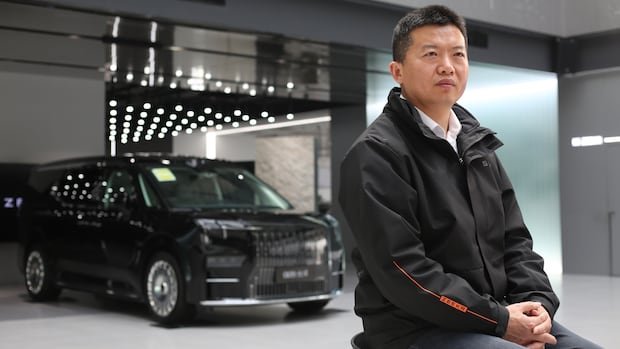

Chinese-made electric vehicles (EVs) are poised to make an impact on the Canadian market following a recent trade agreement. In Ningbo, China, a highly automated “dark factory” churns out Zeekr luxury EVs at an impressive rate of 300,000 cars annually, with robots handling most of the production tasks. This advanced manufacturing process has not only enhanced efficiency but also reduced costs significantly, according to Xu Naiping, the general manager of the factory.
China, a global leader in EV production, has now set its sights on exporting its EV technology to Canada. Prime Minister Mark Carney’s recent negotiations with Chinese President Xi Jinping resulted in a tariff reduction for Canadian imports of 49,000 Chinese EVs. This move has sparked a mix of excitement and concern in Canada.
On the streets of China, the EV revolution is evident, with green license plates marking EVs and innovative features like recliner-style seats and quick battery swaps becoming the norm. The Chinese government’s substantial subsidies, amounting to $230 billion since 2009, have propelled the growth of the EV industry in the country.
While traditional charging infrastructure continues to expand, companies like NIO are pioneering battery-swapping stations as a faster alternative for recharging EVs. This innovative approach has garnered significant attention and adoption among Chinese drivers.
In Canada, the entry of Chinese EVs has stirred both anticipation and apprehension. While some see it as an opportunity to diversify the market and drive EV adoption, others, especially within the Canadian auto industry, view it as a threat to local EV manufacturers. Concerns about data security and competition have also surfaced, with some calling for caution in embracing Chinese EVs.
As Canada cautiously opens its doors to Chinese EVs, the move is seen as a test for Chinese automakers seeking to expand into North America. While challenges lie ahead, the potential benefits of showcasing Chinese EVs in Canada could pave the way for broader market penetration and global recognition for Chinese automakers.