
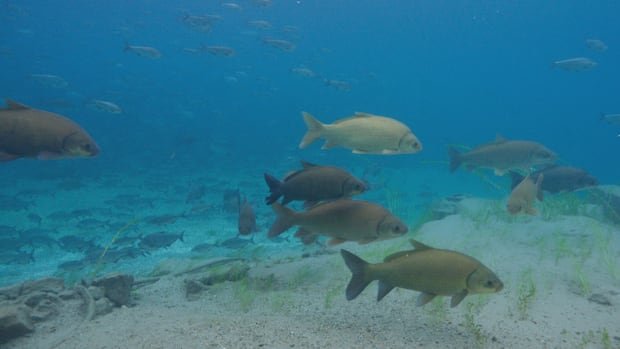

The stunning underwater video footage captured in Lake Huron has led a documentary crew to name a section “fish city” in honor of Earth Day. However, the Saugeen Ojibway Nation (SON) has contested the notion of a thriving fish population around the warm-water discharge area of the Bruce Nuclear Generating Station, labeling it a “fish trap” instead.
SON has drawn attention to the significant death toll of up to five million gizzard shad in 2025, a figure documented by the Department of Fisheries and Oceans (DFO) in a report from the Canadian Nuclear Safety Commission. This mass mortality event occurred when an influx of fish congested the cooling water intake systems, prompting the preemptive shutdown of Bruce A Unit 2 by the utility.
Notably, several lake sturgeon, an at-risk species and culturally significant in Anishnaabe traditions, became stranded in a pond at the plant. While one sturgeon was rescued in November by Bruce Power and SON, three others remain in the area.
The dispute surrounding the “fish city” designation extends beyond mere imagery, sparking discussions on Bruce Power’s management of ecological risks. The company is seeking regulatory approval to enhance plant operations and increase reactor output to generate more electricity.
Despite regulators not attributing the 2025 fish die-off directly to the plant, Ryan Lauzon, a biologist representing SON, highlighted the dual role of attraction and entrapment at the site. Warm water acts as a lure, drawing fish into the plant’s systems, where escape becomes challenging for larger species.
Bruce Power refuted claims linking the plant to the 2025 fish mortality, citing environmental factors such as high shad populations and harsh winter conditions. The utility outlined measures taken to deter fish from entering its systems following the incident.
In its quest for expanded power limits, Bruce Power aims to elevate electricity production without constructing new reactors, with a final hearing scheduled for July 2026. The company asserts that proposed power increases adhere to safety and environmental standards.
Acknowledging a lack of clear benchmarks for assessing fish deaths, particularly in plant systems, Bruce Power operates under stringent regulatory oversight. The absence of defined thresholds for acceptable fish losses underscores the complexity of balancing energy production with environmental considerations.
Gizzard shad, dismissed by some as inconsequential, play a vital role in the lake ecosystem and serve as a crucial food source for various species. The impact of the mass shad die-off reverberates ecologically and culturally, emphasizing the interconnectedness of fish populations and human communities in the region.