
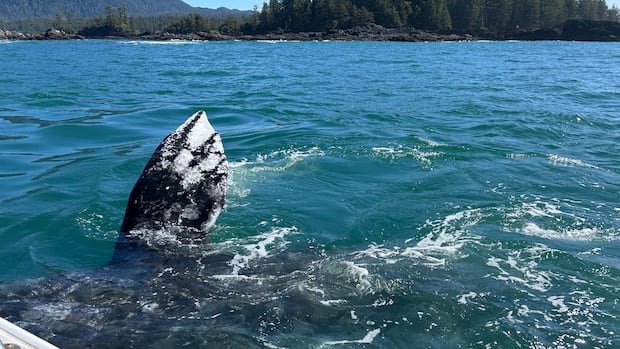

LISTEN | Discover why grey whales are causing concern among scientists:
During the summer months, numerous tourists flock to the Tofino docks in British Columbia, a picturesque town located on the western edge of Vancouver Island. While the area offers a variety of attractions, including beaches and a taco truck, the grey whales steal the spotlight.
Tofino mayor Dan Law expressed the profound experience of making eye contact with a whale, describing it as priceless. However, what many tourists may not realize is that these magnificent creatures are facing critical challenges. Many grey whales are emaciated, starving, and sadly, some are perishing.
“A moment that is worth more than money can buy is when one of those whales will look at you in the eye”– Dan Law, Tofino mayor
Scientists are raising concerns about a potential link to climate change and are advocating for the grey whales to be classified as an endangered species.
So far this year, there have been 10 grey whale carcasses discovered off the shores of B.C., and 30 in Washington state. Unfortunately, it is believed that more whales have perished unnoticed.
Comparing these figures with previous years, the National Oceanic and Atmospheric Administration reported 145 grey whale deaths in Mexico, the U.S., and Canada as of July 8, compared to 179 in the entirety of 2025 and merely 61 in 2024. In 2019, 216 grey whales were found dead as the issue began to emerge.
Renowned whale biologist Jim Darling, with over 40 years of experience in whale research, emphasized the vulnerability of grey whales during their long spring migration, a period when many are found deceased along the shores. This migration covers up to 22,000 kilometers round trip from their breeding grounds in Mexico to Alaska.
Despite various contributing factors to the die-off, climate change is believed to play a significant role. The diminishing Arctic ice and warmer waters are impacting the availability and quality of the whales’ food sources.
Paul Cottrell, the marine mammal coordinator for Fisheries and Oceans Canada, highlighted the insufficient food supply in the whales’ main feeding grounds in the Bering and Chukchi Seas as a probable cause for their current plight.
Grey Whales: From Recovery to Crisis
The grey whale population has faced dire circumstances before. While North Atlantic grey whales were hunted to extinction in the 18th century, the Pacific population narrowly escaped a similar fate. The subsequent recovery was hailed as a success story due to conservation efforts and an international moratorium on commercial whaling.
Darling, who has been studying whales since the 1970s, expressed concerns that the entire grey whale population may once again be at risk. The criteria outlined in Canada’s Species at Risk Act suggest that the smaller segments of the grey whale population, particularly those near Russia’s Sakhalin Islands and around Vancouver Island and northern Washington state, could be classified as endangered.
Slow Progress towards Protection
The Committee on the Status of Endangered Wildlife in Canada recommended nine years ago that a specific group of grey whales be declared endangered. However, Ottawa has yet to make a decision on this matter.
Federal Minister of Fisheries Joanne Thompson acknowledged the critical situation but did not commit to new measures for grey whale protection. Collaboration with scientists, Indigenous communities, and others is underway to gain a deeper understanding of the issue.
Gisele Maria Martin, a guardian of the Tla-o-qui-aht Tribal Parks, emphasized the significance of protecting the environment for future generations, urging residents and visitors to respect the environment by taking the ii-saak pledge.