
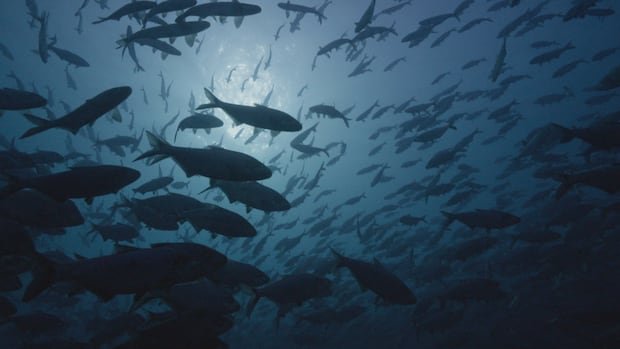

In Lake Huron, fish are congregating in large numbers near an Ontario nuclear plant, creating a captivating spectacle now visible in exceptional detail. Documentary filmmakers Yvonne Drebert and Zack Melnick are utilizing a state-of-the-art underwater drone, valued at $250,000, to capture footage from remote and deep areas of the Great Lakes, a rare endeavor as there are only about 10 similar drones globally, and this specific one operates in freshwater exclusively.
Providing exclusive access to footage from a recent dive, CBC News has revealed a sneak peek ahead of an Earth Day livestream event that will showcase their upcoming documentary titled “Hidden Below: the Great Lakes,” highlighting unique wildlife from the largest freshwater ecosystem on the planet. The focus of the drone’s exploration is the warm water outflow from the Bruce Nuclear Generating Station near Tiverton, Ont., where fish congregate to seek refuge and food in the open water.
Known as ‘Fish City,’ the area near Bruce station is renowned for attracting fish due to its elevated water temperature resulting from the plant’s cooling system discharge. Through the lens of Melnick and Drebert’s cinematic 4K cameras, the rare footage captures a breathtaking scene akin to an oceanic panorama, with countless gizzard shad shimmering in the sunlight alongside various other species like bigmouth buffalo, walleye, bowfin, salmon, trout, catfish, and carp.
Describing the mesmerizing sight as “fish city,” Melnick and Drebert express awe at the dense aggregation of fish in these warm waters. Scientists note that the warmer water in the plume fosters abundant food sources for the fish, leading to enhanced nutrient cycling and accelerated algae growth, thereby attracting a diverse range of species.
Nicholas Mandrak, a prominent freshwater fish biologist from the University of Toronto, remarks on the prevalence of thermal plumes in the Great Lakes, stemming not only from power plant cooling systems but also from industrial discharges, wastewater treatment outflows, and river mouths. While the concentration of fish in the warm waters may appear as a sign of plenty, experts caution that it could signify a fundamental shift in the ecosystem due to the impact of invasive species like zebra and quagga mussels.
These invasive mussels, introduced in the 1980s, have proliferated rapidly, depleting plankton levels in the water and altering the food chain, ultimately leading to changes in fish behavior and distribution. The warmer conditions resulting from the thermal plumes may also jeopardize native fish species adapted to colder waters, affecting ecosystems and communities reliant on these resources.
As the Earth Day livestream event approaches, highlighting the “fish city” phenomenon near the Bruce Nuclear Generating Station, concerns are raised about the broader implications of warm water discharge on the delicate balance of the Great Lakes ecosystem and the livelihoods of those dependent on its resources.