
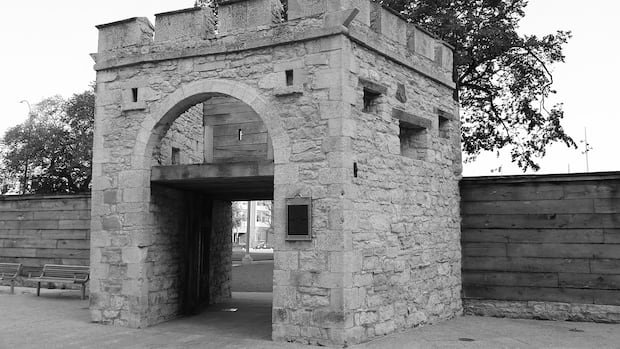

The Hudson’s Bay Company disappeared in June as its final stores closed down, but remnants of its influence in Winnipeg are likely to endure indefinitely. The 355-year-old retailer played a crucial role in the city’s establishment, leaving behind traces in street names, revamped buildings, road layouts, and a trove of historical records.
According to Gordon Goldsborough, the acting executive director of the Manitoba Historical Society, the presence of The Bay will remain palpable due to the numerous indicators of its existence scattered throughout the city. The former six-storey, 650,000-square-foot HBC department store, erected in 1926 at Portage Avenue and Memorial Street, stands as a prominent reminder of the company’s past glory.
While the HBC’s initial department store, which opened in 1881 at Main Street and York Avenue, has been demolished, several ancillary structures constructed by the company in the vicinity still stand. These include the Mail-order and catalogue building (111-117 Fort St.), the Powerhouse building (160 Main St.), the Company garage (115 Garry St., now The Keg), and the Wholesale building (77 Main St., now Gibraltar House).
The Hudson’s Bay Company, established in 1670 with a royal charter for fur trading in Rupert’s Land, encompassing vast territories across North America, including present-day Quebec, Ontario, Nunavut, the Prairies, and parts of the U.S. The company’s legacy is evident in the names of various streets in Winnipeg, honoring former HBC posts, employees, and trade merchants.
As the city developed, the HBC played a pivotal role in urban planning and real estate ventures. The company’s influence can be seen in the distinct street layout within its reserve, featuring wider streets and larger blocks compared to other areas of Winnipeg. The legacy of HBC’s imprint is visible in the city’s infrastructure and urban planning.
Despite its historical significance, the Hudson’s Bay Company’s colonial practices and impact on Indigenous communities must also be acknowledged. In a symbolic gesture towards reconciliation, the HBC’s former Portage Avenue store was handed over to the Southern Chiefs’ Organization in 2022 for redevelopment as a mixed-use space, marking a significant step towards acknowledging the past and fostering unity.
The rich history and artifacts preserved in institutions like the Manitoba Museum and Manitoba Archives serve as a testament to the HBC’s enduring legacy in Winnipeg’s history. These repositories hold valuable records dating back to the 1600s, providing insights into the company’s operations and contributions to the region’s development.
The transition of the former HBC building to Indigenous ownership signifies a transformative moment in acknowledging the past and working towards a more inclusive future. The move is seen as a beacon of hope and a significant stride towards reconciliation and understanding of the complex legacy of the Hudson’s Bay Company in Winnipeg.