
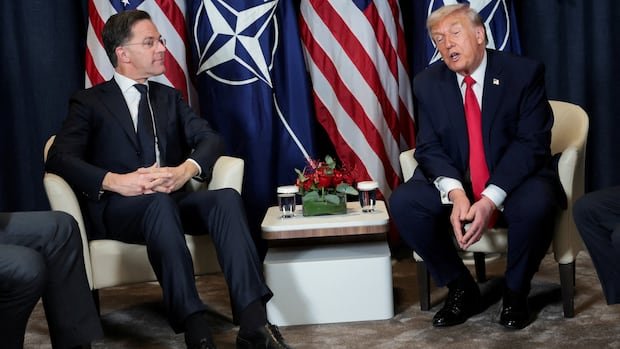

In spite of U.S. President Donald Trump’s expressed desire and the social media buzz surrounding it, a separation between the United States and NATO would be extremely difficult to accomplish due to the lack of mutual interest at this time. This was highlighted during the recent meeting between Trump and NATO Secretary General Mark Rutte.
The meeting followed Trump’s statement to Reuters about considering withdrawal from NATO after allies declined to participate in the American-Israeli campaign against Iran. The tension escalated when White House press secretary Karoline Leavitt remarked that NATO had failed a test and turned their backs on American taxpayers who fund their defense.
Although there was anticipation of a potentially damaging conversation between Trump and Rutte, the outcome was less severe than expected. Trump criticized NATO on his Truth Social account, claiming they were not there when needed and won’t be there in the future. Rutte, on the other hand, emphasized the alliance’s significance as a U.S. partner in a speech.
An official from Trump’s administration mentioned a potential move to penalize allies who didn’t support the American-Israeli operation. Despite the rhetoric damaging NATO’s reputation, the likelihood of the U.S. taking concrete steps to undermine the organization remains uncertain.
Former Canadian ambassador to NATO Kerry Buck suggested three possible scenarios if the U.S. were to seriously consider leaving or punishing NATO. These scenarios include subtle withdrawal tactics, reluctance to engage in crises, or issuing a full withdrawal notice, which would require congressional support.
Support for NATO among Americans remains high, but Republican backing has slightly declined. Exiting NATO could result in the U.S. losing European military bases and defense industry clients, ultimately benefiting Russia by weakening NATO’s deterrence capability.
While some analysts predict catastrophic consequences if the U.S. exits NATO, others question if Europe is willing to maintain the alliance. The International Institute for Security Studies highlighted the financial and capability challenges Europe would face without U.S. involvement.
Former U.S. Ambassador to NATO Ivo Daalder emphasized the need for European allies to invest more in defense and reduce reliance on the U.S. In light of the strained relations caused by the Iran crisis, concerns about the future of NATO persist among members.
The possibility of a denunciation under Article 13 of the Washington Treaty, allowing members to exit with a year’s notice, remains uncharted territory. The uncertain future of the U.S.-NATO relationship underlines the complex dynamics at play within the alliance.
[Source](https://www.cbc.ca/news/politics/nato-trump-iran-war-russia-9.7158165)